Why a Reading Logbook KDP Interior Can Transform Your Self-Publishing Business
Creating a steady stream of high-quality, low-content books for Amazon Kindle Direct Publishing often feels like a balancing act between creativity and efficiency. You want products that resonate with readers, yet the design phase can eat up hours you simply don’t have. This is precisely where a ready-made Reading Logbook KDP Interior steps in. Instead of staring at a blank canvas, you start with a professionally structured template that understands the functional and emotional needs of every book lover. From tracking daily reading habits to listing favorite quotes and forthcoming titles, a well-designed logbook interior becomes a personal companion. As a self-publisher, having access to a fully editable source file means you can scale your catalog without compromising on quality or burning out on repetitive layout work.
What Exactly Defines a Reading Logbook KDP Interior?
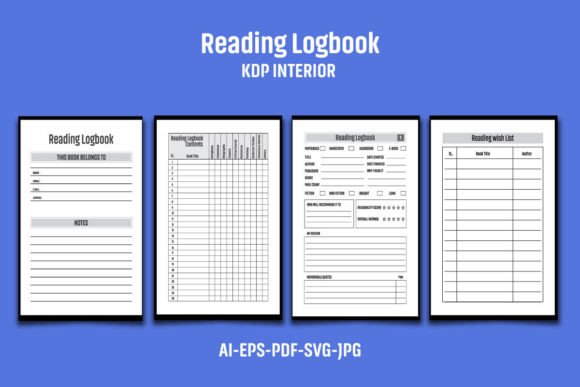
At its core, a Reading Logbook KDP Interior is a pre-designed, print-ready template created specifically for the 8"x10" paperback format—including bleed. It is not a finished book you simply upload. Instead, it’s the structural backbone: every page from the title page to the final review section, laid out with consistent margins, typography, and a logical flow. Unlike generic templates, this particular interior focuses entirely on the reading experience. You’ll find dedicated spaces for recording the book title, author, genre, start and finish dates, page count, rating, notes, and memorable quotes. Some sections might include prompts for reflections or prompts to plan the next read. The beauty lies in its purposeful simplicity: black and white pages that look crisp in print, keep printing costs low, and never distract from the user’s own handwriting.
When you access the package, you receive a comprehensive bundle of source files. You get one AI file, one EPS file, a ready-to-upload PDF, four high-resolution JPG files for quick previews, and an SVG file. The inclusion of Illustrator AI and EPS CS6 versions is particularly valuable because it lets you dive into deep customization if you’re comfortable with vector editing. Even the PDF itself contains 110 pages, which offers a generous volume that feels substantial to the buyer without becoming unwieldy. This count often strikes the right balance between a journal that lasts a meaningful amount of time and a manageable production cost.
File Compatibility and the Designer’s Workflow
The assortment of file types bundled with a Reading Logbook KDP Interior is not about redundancy; it’s about fitting into vastly different workflows. Consider how you might approach customization:
- For the Adobe Expert: The native AI file gives you complete control. You can edit every stroke, adjust text boxes, swap fonts, or even rearrange the order of sections. Because you’re working in vector, scaling or repositioning elements never degrades quality.
- For the Cross-Platform Designer: The EPS file opens in dozens of applications beyond Illustrator, including CorelDRAW and Affinity Designer. This ensures you aren’t locked into a single software ecosystem.
- For the Efficiency-Focused Publisher: The high-resolution PDF (300 DPI) can often be used almost as-is after you’ve added your branding. You might slip in a custom title page or insert a small logo on the copyright page, then generate a fresh PDF for KDP. The straightforward structure means you can honestly be upload-ready within minutes.
- For the Quick Visualizer: The four JPG files are perfect for creating product mockups or listing images without needing to open a heavy design program. They give you a snapshot of what the printed pages will feel like.
- For the SVG Enthusiast: The SVG file is a lightweight alternative that integrates smoothly with web-based design tools or even some cutting machine software, extending the interior’s life beyond a single printed book.
All these elements are compressed into a single ZIP file, so you will need to extract them using a tool like WinZIP, WinRAR, or a standard double-click extraction depending on your operating system. The extraction step is straightforward, but it’s the gateway to a powerful creative toolkit.
Why the 8"x10" Format Matters for Reading Journals
Paperback dimensions heavily influence how a reader interacts with a logbook. The 8"x10" size with bleed (overall dimensions of 8.12 x 10.25 inches) is a deliberate choice that marries spaciousness with portability. A smaller 6"x9" layout can feel cramped when someone wants to write detailed reflections or paste a small thumbnail of the book cover. An oversized 8.5"x11" might feel too close to a school textbook. The 8"x10" hits the sweet spot: wide enough to comfortably accommodate lines for book titles and generous note sections, yet compact enough to slide into a tote bag or sit on a nightstand.
Bleed is often overlooked by newcomers but critical for a polished final product. Because the interior includes bleed, your backgrounds or any elements that touch the edge of the page will print cleanly without unsightly white slivers. Amazon KDP’s print-on-demand machinery can sometimes shift pages slightly; bleed is your insurance policy against that variability. When you upload a Reading Logbook KDP Interior that already respects these trim margins, you sidestep the technical rejections that plague many first-time publishers.
Navigating KDP’s Duplicate Content Flags with Smart Customization
Amazon KDP actively monitors its marketplace for duplicate content—multiple sellers offering identical interiors. This protects the customer experience but poses a real challenge for anyone using a commercially available template. Simply downloading a Reading Logbook KDP Interior and uploading it unchanged is risky. The note included with the product is a friendly but essential warning: you need to create your own interiors to upload on Amazon KDP. Please add your logo or graphic to the interior page before uploading to KDP to prevent any flags for duplicate content.
This doesn’t require a complete redesign. Small, authentic changes transform a template into a unique product. Start by replacing the default title page with your own book title. Insert a subtle graphic element—perhaps a small open book icon, a decorative leaf, or a geometric divider—on a handful of interior pages using the AI or EPS file. Change the font in the headers to one that has an appropriate commercial license but still conveys your brand’s mood. Add a personal dedication page or an “About This Logbook” section that explains your inspiration. Even swapping the sequence of a few sections can differentiate your version from others on the market. These adjustments are simple in Illustrator or Affinity Designer, and they protect your KDP account while building a recognizable brand identity.
Designing for the End User: Functionality Beyond the Obvious
A reading logbook succeeds when it feels intuitive. A thoughtfully constructed interior doesn’t just present blank lines; it anticipates the reader’s journey. Think about the way you organize the 110 pages. The first few pages might set the tone with a reading challenge tracker or a list of literary goals. The core logging section can be structured with a double-page spread: the left side captures the raw data (title, author, dates, rating), while the right side offers a freeform area for personal thoughts. This layout respects the natural flow of recording information before diving into reflection.
Because the entire interior is black and white, color changing is easy if you decide to introduce a soft gray for guide lines or a specific ink-saving shade for grid sections. The 300 DPI resolution ensures that even the thinnest of lines reproduces sharply, which is vital when you’re printing a page of tiny table cells or cursive prompts. High resolution also means the interior looks professional if a customer photographs the pages for a social media post—an indirect but powerful marketing boost for your book.
How This Interior Bridges the Gap Between Hobbyist and Pro Publisher
Many self-publishers start with a passion for a niche—here, it might be books about books—but lack formal graphic design training. The Reading Logbook KDP Interior package removes the intimidating technical barriers. Instead of learning margin settings from scratch or calculating spine width, you receive a proven template. This accelerates the journey from idea to published listing. You can test the market quickly, see what resonates, and iterate. If one design aesthetic flops, you still have the source files to reimagine the interior with a different theme—minimalist, boho, academic, or playful—without purchasing a new template.
The inclusion of four JPG preview files is particularly helpful for creating compelling Amazon listing images. You can select a few representative pages, overlay text or mockup devices on them, and present a clear picture of what’s inside. Customers buying a reading journal online cannot flip through physical pages, so these visual cues become your virtual storefront.
Practical Considerations Before You Hit “Publish”
Before launching a book built from this interior, double-check a few housekeeping items. Although 110 pages are pre-built, you can shorten or lengthen the PDF within the design software by duplicating or removing specific pages. Keep in mind that KDP requires an even total page count for a paperback to calculate the spine correctly, so plan accordingly. The download comes as a ZIP file, so extracting it is step one; organize your files in a dedicated project folder so the AI, EPS, and PDF versions don’t get mixed up between projects.
When you add your logo or graphic, ensure it sits comfortably within the safe margins—no closer than about 0.375 inches from the trim edge. Even with bleed, text too close to the edge can feel crowded when the book is bound. Finally, always order a physical proof copy. The on-screen proofing tools are decent, but only a printed sample reveals whether the grayscale values are balanced, the paper texture feels right, and the overall heft satisfies your vision for a reading logbook.
Extending the Value of a Single Purchase
Once you master customizing this Reading Logbook KDP Interior, you hold a versatile asset. The same basic structure can be subtly altered to produce multiple variations for different audiences. You might create a “Book Club Reading Logbook” with discussion question prompts, a “Summer Reading Challenge Log” with themed artwork, or a “Classic Literature Logbook” with pre-printed lists of canonical works. Each variation targets a distinct keyword and customer segment while the underlying template remains the same. The SVG file, often underutilized, can even be adapted to create a companion digital product or a printable page for a planner shop outside of KDP, giving you cross-platform income streams.
The initial investment in a well-prepared interior can thus yield returns far beyond a single ASIN. It becomes a foundational tool that grows with your publishing business, reinforcing the idea that smart publishers don’t just sell books—they build systems that let them create consistently and sustainably.
A Note on File Extraction and Handling
It’s worth reiterating that the delivered package is a compressed ZIP file. Some might rush past this detail and attempt to open a corrupted version. Use WinZIP, WinRAR, or the built-in extraction tool on your computer: a simple right-click and “Extract All” usually suffices. Once extracted, you’ll find the batch of files—AI, EPS, PDF, JPGs, and SVG—all individually ready. Organize them in a folder named after your upcoming book project, and back up the original ZIP in cloud storage. This small habit saves frustration later when you want to return to a fresh version of the interior.
Ultimately, a Reading Logbook KDP Interior is more than a product; it’s a partnership between design efficiency and your own creative instinct. The best interiors fade into the background, letting the reader’s experience take center stage. When you add your unique touch and publish with care, you aren’t just uploading another notebook. You’re offering a companion that might sit on someone’s shelf for years, gradually filling with the spine-creases and coffee stains that mark a true reading life.