Understanding the Checking Account Ledger Notebook KDP Interior: What You Get and How It Compares
When building a KDP publishing business around low-content and medium-content books, the interior design often determines half the work. A Checking Account Ledger Notebook KDP interior gives sellers a head start: a fully formatted, printable structure that only needs light personalization before upload. Rather than starting from a blank InDesign or Illustrator canvas, you get a ready-to-use template created specifically for Amazon’s paperback specifications. This kind of product sits between a raw DIY approach and outsourcing to a designer, offering a practical middle ground that many independent publishers find appealing.
Below, we explore what these interiors actually include, how they compare with building your own from scratch or pursuing custom alternatives, the tradeoffs involved, and the situations where this type of resource makes the most sense. The goal is to help you decide whether a Checking Account Ledger Notebook KDP interior aligns with your publishing goals, time constraints, and desired level of originality.
What’s Inside a Checking Account Ledger Notebook KDP Interior Product
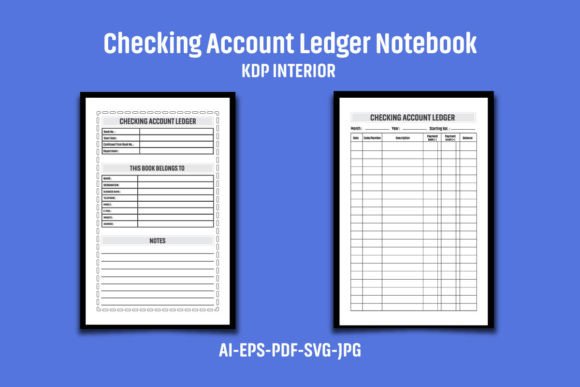
Most products labeled as a Checking Account Ledger Notebook KDP interior deliver a collection of editable files packed into a single ZIP archive. A standard bundle includes an AI (Adobe Illustrator) file, an EPS file, a PDF, two JPG preview images, and an SVG file. The core deliverable is the 110-page PDF, already set to the 6×9-inch trim size with full bleed. The interior’s overall dimensions stretch slightly to 6.12 by 9.25 inches, giving the printer the space it needs to cut cleanly. Every page is black and white, which not only meets Amazon KDP’s printing requirements for paperbacks but also keeps production costs predictable.
The design itself is a repetitive ledger format—lined spaces for date, check number, transaction description, debit, credit, and balance. Because the files are vector-based and fully editable, you can change the color of ruling lines, adjust font styles, or even swap out headers if you have basic Illustrator skills. The note “Easy to color change” is literal: selecting all elements and applying a new stroke color takes seconds. That flexibility means you can adapt one interior to produce multiple variations—perhaps a blue-lined version, a seafoam green version, and a charcoal gray version—without rebuilding the grid each time.
All files are prepared at 300 DPI, which satisfies Amazon’s resolution expectations and ensures sharp output. The inclusion of CS6-compatible AI and EPS files makes the interior accessible even for those running older software versions. What’s not included: cover design, mockup images, or any branded text inside the pages. Those visual elements appear only in product previews and are not part of the downloadable ZIP. Sellers must add their own logo, copyright page, or subtle graphic mark inside the book before publishing, a step that helps avoid the duplicate content warnings Amazon sometimes triggers when identical files are uploaded by multiple users.
How a Ready-Made Ledger Template Compares to Building From Scratch
The alternative to buying a ready-made interior is creating every page manually. This comparison isn’t just about money; it’s about time, skill, and the quality of the final result. A Checking Account Ledger Notebook KDP interior cuts down hours of layout work, but it also introduces some limitations that a fully custom build wouldn’t have. Understanding both sides helps you weigh the decision.
Time and Skill Investment
Designing a 110-page ledger from scratch in InDesign, Illustrator, or even Canva requires intermediate-level knowledge of master pages, paragraph styles, and bleed settings. Aligning 30+ horizontal rows per page, maintaining consistent gutter margins, and linking to the exact dimensions Amazon mandates is detail-intensive. An experienced designer might complete this in three to four hours; a beginner could easily spend a full day troubleshooting alignment or export issues. With a ready-made interior, you download, make your adjustments, export, and you’re done in under an hour. The tradeoff is that you’re working within someone else’s column arrangement and typography choices. Modifying the structure beyond color changes requires comfort with vector paths, which may still demand a learning curve.
Consistency and Professional Appearance
A professionally made interior eliminates the risk of uneven row spacing, misaligned headers, or accidental font substitutions. The seller built it to a specific grid, checked against print proofs, and exported with bleed intact. When you build from zero, small inconsistencies often sneak into the back pages, especially if you manually duplicate artboards without rigorous version control. For a checking account ledger—where precise alignment of debit and credit columns matters for user trust—this baseline consistency can be worth the price.
Strengths and Tradeoffs of Using a Premade KDP Ledger Interior
Like any publishing tool, a Checking Account Ledger Notebook KDP interior has clear strengths and a few tradeoffs that become more noticeable depending on your niche and audience expectations.
Strengths:
- Speed to market. You can have a paperback live on Amazon within a day of purchase, assuming your cover is ready and you perform the required interior customization.
- Cost efficiency. Hiring a designer for a single 110-page layout might cost fifteen to thirty times more than buying a template. For new publishers testing a market, this keeps initial risk low.
- No starting from zero. The interior is already built for KDP, with the correct page count, bleed, and color mode. You avoid the trial-and-error phase new sellers often face.
- Editable source files. Having the AI, EPS, and SVG versions means you can alter more than just color. Remove logos, reshape tables, or export individual pages for other platforms.
Tradeoffs:
- Not one-of-a-kind by default. Without meaningful changes, the same interior could appear in other sellers’ books. Amazon’s system occasionally flags identical interiors, which is why the product note strongly recommends adding a unique logo or graphic to each page.
- Fixed page count. The 110-page length is set. If your market research suggests a 120-page or 150-page ledger sells better, you either need to extend the file yourself (cloning and inserting pages while maintaining pagination) or look for a different template.
- Software requirements. Full editing of the AI and EPS files demands Adobe Illustrator or a compatible vector editor. Altering only the PDF through a free editor limits your options to basic additions.
Deciding When This Type of Interior Is the Right Choice
A Checking Account Ledger Notebook KDP interior works best when a handful of conditions line up. You might be an established seller expanding into personal finance stationery and need a reliable, clean layout quickly. Perhaps you’re testing whether “checkbook registers” resonate with your audience before commissioning a fully bespoke design. The interior is also suitable for publishers who prioritize simplicity: the ledger format is timeless, and customers looking for a straightforward transaction log don’t demand elaborate decorative elements. In those cases, a well-executed black-and-white interior with subtle custom branding offers excellent utility and value.
The product is particularly useful when you already have experience with Amazon’s publishing process. You understand that KDP isn’t just about throwing a file online; it’s about validating trim sizes, previewing, and ordering a proof copy. Since this interior already addresses the technical complexity, you can focus your energy on cover design, keywords, and category selection—factors that often influence sales more than the ledger lines themselves.
When You Might Consider Alternatives Instead
There are clear scenarios where a premade template, no matter how well-crafted, would not be the optimal path. If your brand relies on hand-drawn accents, watercolor borders, or a distinctive visual identity, even a color-changed ledger may still feel generic. A custom illustrator or a designer who builds an interior from your style guide might be the better investment. Similarly, if you plan to sell a large volume and need to stand out in a competitive subcategory, starting from a blank canvas allows for unique page numbers, motivational quotes, or a hybrid layout that combines a ledger with a budgeting worksheet—features no off-the-shelf interior includes.
Another consideration is print cost. A 110-page black-and-white interior will price within a standard range, but if you were hoping to offer a full-color ledger or a premium spiral-bound feel through KDP (which only offers perfect binding), this product won’t change those constraints. The interior is optimized for what KDP already does well: a no-frills, ink-friendly notebook.
Custom Illustrator Design vs. Template Modification
To put the effort into perspective, imagine a scenario where you need a ledger with a subtle column for “Category” alongside the standard fields. With the template, you would open the AI file, duplicate the text fields, add a new vertical ruling line, and adjust spacing—work that might take 30 minutes if you’re comfortable with the pen tool. A custom designer, on the other hand, would build you that exact layout from scratch, perfectly balanced, but the turnaround could be days and the cost significantly higher. The template gives you a solid foundation; a custom job gives you an exact bespoke result. Neither is universally better, but the template often wins when time and budget are primary constraints, while the design is close enough to your vision.
Practical Steps to Publish Successfully and Avoid Duplicate Content Flags
Regardless of how you obtained the interior, Amazon KDP requires each publisher to take ownership of the file’s uniqueness. The product instructions emphasize this clearly: “Please add your logo or graphic to the Interior page before uploading to KDP to prevent any flags for duplicate content.” This isn’t a suggestion—it’s a protective measure. Adding a small, unobtrusive logo on every page or even a simple geometric shape in a corner differentiates your version immediately. You can also modify the header font, adjust the line weight, or add a unique copyright notice. These small changes signal to Amazon’s review system that the interiors are distinct, reducing the chance of a block or an account-level notice.
Before you upload, unzip the compressed folder using WinZIP, WinRAR, or your operating system’s built-in extraction tool. Double-check that you’re working with the extracted files, not the compressed archive. Preview every page in the PDF to confirm that your customizations appear consistently. Finally, order an author proof copy to see how the ledger lines actually print on Amazon’s paper—sometimes line thickness that looks perfect on screen appears too faint or too heavy in a physical book.
Who Benefits Most from a Checking Account Ledger Notebook KDP Interior
Several types of KDP creators will find this resource especially useful:
- First-time publishers who want a low-risk way to learn the upload and review process without battling design software.
- Stationery line builders who already sell budgeting workbooks, bill planners, or expense trackers and want to add a complement without diluting their brand.
- Volume-focused entrepreneurs who aim to publish multiple variations (e.g., a blue ledger, a pink ledger, a compact 6×9 ledger) quickly by re-coloring the same AI file.
- Educators and coaches who create their own client resources and need a professional, non-decorative layout that clients can actually use for real checkbook balancing.
In all these cases, the interior removes a significant technical hurdle, allowing the creator to concentrate on the overall product experience—cover, description, niche targeting—rather than getting stuck on page layouts.
Making a Confident Decision for Your KDP Catalog
Every KDP seller eventually reaches a point where they must choose between doing it all themselves, buying ready-made components, or hiring help. A Checking Account Ledger Notebook KDP interior represents a pragmatic choice: it gives you the bones of a well-structured book, leaves room for you to imprint your identity, and speeds up the time between idea and published product. The key is approaching it with clear eyes. You aren’t getting an exclusive, never-seen-before design out of the box, but you are getting a tested, editable structure that can be tailored enough to feel like your own. When you weigh the realistic alternatives—days of layout work, higher upfront design fees, or the risk of a poorly formatted DIY attempt—the template often lands as the most sensible option for a wide range of publishing scenarios. Just remember to make those small but essential tweaks, and you’ll turn a versatile interior into a book that sits comfortably in your own brand’s catalog.