Why a Savings Planner Changes Everything About How You Handle Money
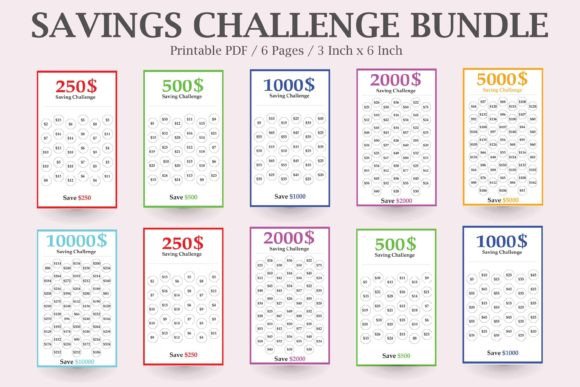
Most people have a vague idea of what they're saving for. A house someday. An emergency fund eventually. Retirement, maybe. But vague intentions rarely translate into real results. The gap between wanting to save and actually doing it consistently is where a Savings Planner becomes indispensable. It's not just a piece of paper or a file on your computer. It's a commitment device, a visual tracker, and a quiet accountability partner all rolled into one thoughtfully designed product.
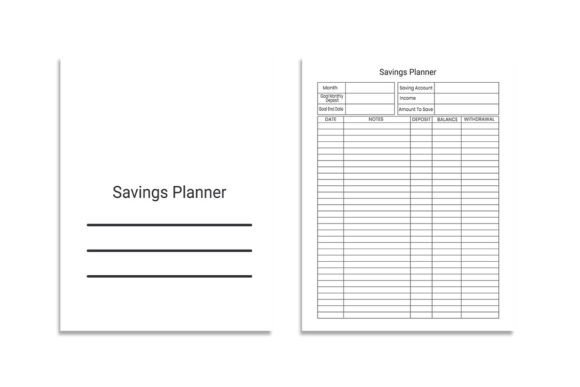
What makes this particular Savings Planner stand out is its versatility and professional finish. The download includes AI files, PDF files, and SVG files, all formatted at high resolution with 300 DPI and CMYK color. That combination matters more than most people realize, especially if you intend to print and reuse the planner or integrate it into a larger organizational system. Two pages might sound minimal, but in practice, that's exactly the right amount of space to stay focused without getting overwhelmed.
Moving Beyond Spreadsheets and Mental Math
Spreadsheets work for some people. For others, they're a chore. Opening Excel or Google Sheets to manually update savings figures can feel clinical and disconnected from the emotional payoff of watching progress happen. A physical or printed Savings Planner changes the experience entirely. There's something satisfying about filling in a box, coloring a progress bar, or writing down a milestone reached. It activates a different part of the brain, one that craves tangible feedback.
Research in behavioral psychology consistently shows that people who track goals visually are significantly more likely to achieve them. The act of recording progress creates a feedback loop. You see the gap shrinking between where you are and where you want to be, and that visual evidence fuels continued discipline. This planner taps into that dynamic directly. It's not overly complicated, and that's precisely the point. Complexity kills consistency. Simplicity, paired with clarity, builds momentum.
The Design Features You'll Actually Use
Let's talk about the technical specifications because they directly impact usability. The files arrive in three formats. AI files are native Adobe Illustrator documents, fully editable if you want to customize headings, add your name, or tweak the layout to match a specific savings goal. PDF files are ready to print immediately, no fuss, no adjustments needed. SVG files offer scalable vector graphics that integrate beautifully with cutting machines like Cricut or Silhouette if you want to create stickers, decals, or custom printed elements.
Everything is rendered at 300 DPI, which is the gold standard for sharp, professional printing. Whether you take the files to a local print shop, use a home inkjet, or send them to an online printing service, the output will look crisp. The CMYK color profile ensures that what you see on screen translates accurately to ink on paper. RGB screens and CMYK printers don't always agree, but when files are prepared in the correct color space from the start, you avoid dull or unexpectedly shifted colors. The planner's color palette remains vibrant and true.
Two pages might raise an eyebrow if you're used to thick planners. But consider the psychology here. A single sheet, front and back, is digestible. It doesn't intimidate. You can pin it to a bulletin board, clip it to the fridge, or slip it into the front of a binder where you'll see it daily. Visibility is half the battle with any savings goal. The Savings Planner thrives on this principle of prominent, unavoidable placement.
How a Savings Planner Fits Into Modern Financial Life
Financial apps dominate the conversation these days. Mint, YNAB, EveryDollar. They're powerful, but they also live inside a phone that's constantly buzzing with notifications, distractions, and temptations to spend. A dedicated Savings Planner exists outside that ecosystem. It's a deliberate artifact. When you interact with it, you're not also being pulled toward social media, email, or impulse shopping. That separation is becoming increasingly valuable in a hyperconnected world.
For freelancers, gig workers, and small business owners, income fluctuates. Fixed budgeting apps sometimes struggle to accommodate irregular cash flow. A savings planner offers flexibility. You can set a target number and fill in progress as funds become available, without rigid monthly deadlines that don't match your reality. It adapts to your life rather than forcing your life into a template.
Parents teaching children about money will also find unexpected value here. Kids understand visual trackers. A printed Savings Planner hung on the wall, where a child can color in sections as they save allowance or gift money, transforms abstract numbers into a game. The editable AI files mean you can even create simplified versions specifically for younger users, with larger text or playful icons.
Real Scenarios Where This Planner Excels
Imagine you're saving for a vacation. The total cost is $2,400. You break that into 24 increments of $100 on your two-page planner. Each time you set aside $100, you fill in a segment. Watching those segments accumulate is genuinely motivating. It's not gamification in the shallow sense. It's a physical manifestation of delayed gratification, which is a skill that benefits every single area of life.
Now picture an emergency fund goal. Financial advisors typically recommend three to six months of living expenses. That number can feel enormous and discouraging. A Savings Planner lets you chunk it down. Instead of staring at $15,000 as one overwhelming figure, you're looking at manageable milestones of $500 or $1,000. The planner breaks the psychological barrier that causes many people to give up before they start.
Couples saving together for a down payment on a home face unique dynamics. Two people, two sets of spending habits, one shared goal. Printing two copies of the planner or sharing a single prominent one in the kitchen creates transparency. You're both looking at the same visual reminder, the same progress, the same remaining gap. It turns an individual financial effort into a visible team project.
Print Quality and Customization Potential
The inclusion of editable AI files is a detail that deserves emphasis. Most downloadable planners lock you into the designer's exact layout. That's fine if it matches your needs perfectly. But savings goals are personal. One person might be tracking a wedding fund. Another is building a car replacement fund. Another is focused on holiday spending. The ability to open the AI file and change section labels, goal categories, or even the color scheme means this single purchase adapts to years of different financial objectives.
High-resolution 300 DPI output guarantees that even small text remains legible. If you choose to scale the planner up for a larger poster print, the vector nature of the AI and SVG files means zero quality loss. CMYK color management protects against the dreaded neon-green-turned-muddy-olive problem that plagues poorly prepared print files. These are specifications that graphic designers obsess over, and they're built into the product already.
For those who enjoy planner communities, bullet journaling, or creative budgeting circles, the SVG format opens up possibilities for stickers, washi tape templates, and decorative elements that coordinate with the planner's design. It's not just a static document. It's a resource that plays well with other creative tools people already own.
The Connection Between Planning and Accountability
Accountability sounds serious, maybe even unpleasant. But in practice, it simply means having a system that reminds you of your own intentions. Left to memory alone, financial goals fade. Daily expenses feel urgent. Long-term savings feel abstract. The Savings Planner bridges that perceptual gap by putting your goal in front of your eyes, physically, repeatedly.
Some people pair the planner with a dedicated savings account. They update the planner each time they make a transfer. Others use it in cash envelope systems, tracking the growing balance of a physical envelope stored at home. The flexibility accommodates whatever broader financial method you prefer. The planner doesn't dictate your strategy. It supports it.
There's also a social dimension worth considering. When guests visit and see a savings tracker on the fridge, it normalizes financial goal-setting. It sparks conversations. Friends might share their own goals. Kids absorb the idea that saving is a normal, visible, celebrated part of adult life rather than a hidden or stressful topic. Cultural shifts often start with small, visible practices.
Practical Considerations Before You Start
Choosing the right savings goal matters. The planner works best with specific, measurable targets. Vague goals produce vague results. Before printing, ask yourself what exactly you're saving for, how much it costs, and by when you'd like to reach it. Write those details on the planner itself. The act of defining parameters sharpens your focus.
Decide where the completed planner will live. Visibility drives consistency. A desk, kitchen wall, or household command center all work well. Avoid tucking it into a drawer. The whole point of a Savings Planner is to be seen regularly.
Consider how you'll mark progress. Some people prefer colored pencils or markers for filling in sections. Others use stickers, stamps, or washi tape. The method matters less than the regularity of the ritual. Updating the planner becomes a small celebration, a moment of acknowledgment for the discipline you exercised during the week or month.
If you're technically inclined, you can print multiple versions from the editable AI files, each tailored to a different savings category. One for short-term goals like gifts and travel. Another for medium-term targets like a new appliance or vehicle maintenance fund. A third for long-term objectives like a home deposit. Layering these planners creates a comprehensive but visually clear financial picture without requiring a single complicated document.
Why File Formats and Print Specs Actually Matter
The difference between a blurry, pixelated printout and a crisp, professional-looking planner comes down to resolution and color space. 300 DPI is the minimum threshold for print quality that doesn't strain the eyes. Anything lower and text edges soften, fine lines break, and the overall impression feels cheap. Cheap materials undermine serious goals. A beautifully printed planner signals that your savings objective deserves quality attention.
CMYK color sits at the heart of commercial printing. Monitors display color as light, using the RGB spectrum. Printers layer ink using cyan, magenta, yellow, and black. When files are prepared in CMYK from the outset, the designer has already accounted for the way colors shift during printing. You don't end up with disappointing surprises. The gray stays gray instead of turning purple. The greens stay natural instead of fluorescing. These subtleties influence how you feel about using the planner over time.
The two-page format also aligns with standard printing on a single sheet of paper, double-sided. Minimal waste, easy to replace if needed, and compatible with basic home printers. You don't need specialized equipment or a trip to the print shop, though both options work. The files are sized and structured for everyday usability.
Integrating the Savings Planner Into a Broader System
A Savings Planner works beautifully alongside other tools. Budgeting apps handle transaction tracking. Investment platforms manage long-term growth. The planner occupies a specific niche: active, short-to-medium-term savings goals that benefit from constant visual reinforcement. It doesn't try to do everything. That restraint is a feature, not a limitation.
For people who already practice zero-based budgeting, the planner functions as a dedicated tracker for sinking funds. For those following the 50/30/20 rule, it provides a tangible home for the savings portion. For individuals simply trying to build better habits, it's a low-friction entry point that doesn't require learning complex software or adopting an entire financial philosophy overnight.
Teachers and financial coaches can incorporate the planner into workshops or client sessions. Because the files are printable and sharable (within the bounds of the license), a single download supports repeated use across multiple participants. The editable AI files let facilitators create customized versions for different workshop themes—saving for education, travel, home ownership, or debt payoff milestones.
Observing What Works Over Time
People who stick with a Savings Planner often report a shift in how they experience saving. It stops feeling like deprivation and starts feeling like progress. This emotional reframe is significant. When saving feels like withholding from yourself, it's unsustainable. When it feels like building toward something meaningful, it becomes self-reinforcing. The planner externalizes that positive narrative.
Some users find that after reaching their first goal, they immediately set a second one. The momentum carries forward. Others discover that the clarity provided by the planner reveals misaligned priorities. Maybe they thought they wanted to save for a luxury purchase, but actually, the process of tracking made them realize travel mattered more. That kind of self-knowledge is valuable, and it emerges from consistent engagement with a simple tool.
Ultimately, a savings goal achieved is more than the money accumulated. It's evidence of your ability to commit, plan, and follow through. The Savings Planner documents that evidence. Years later, a filled-in planner pulled from a drawer is a record of discipline, a reminder that you are capable of directed patience. That's worth far more than the paper and ink it took to create it.