Mastering Your Instrument with the 5 String Tab Notebook
Writing music by hand has never been a casual act. It’s a decision to slow down, to treat an idea with enough respect that it deserves permanent space. For players of five-string instruments—whether bass, banjo, or custom setups—the 5 String Tab Notebook becomes a strategic asset, not just a place to jot down a riff. This interior has been designed and tested specifically for KDP, meaning publishers, teachers, and musicians can upload a professional-grade resource directly to Amazon or print it on demand. But the real value goes deeper: the way you use this notebook can change how you set goals, track progress, and think about your musicianship over the long run.
Why a Dedicated Tab Notebook Matters for Serious Musicians
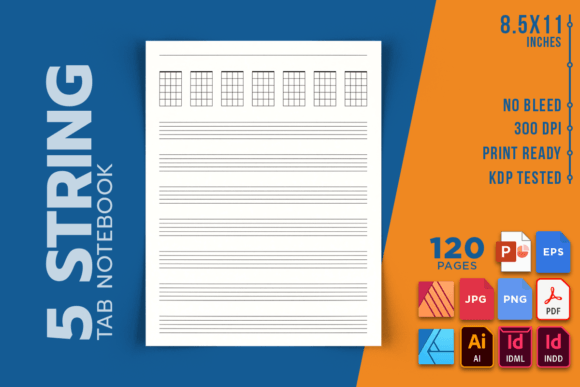
We live in an endless stream of apps, voice memos, and sticky notes. The result is often a scattered collection of fragments without context. A physical tab notebook forces a different kind of focus. When you put pen to a pre-formatted five-string staff, you’re making a choice to commit—to organize your thinking in a way that digital tools rarely encourage. The 5 String Tab Notebook provides 120 pages of clean tablature, exactly sized at 8.5 x 11 inches. That room lets you write out full bass lines, chord progressions, or fingerings without cramping. No bleed means every page stays crisp, whether you’re photocopying a chart for a student or handing out sheets at a rehearsal. The 300 DPI quality in the downloadable file ensures that what you see on screen will translate perfectly to physical copies. For performers and educators who rely on clarity, this is a quiet but powerful reliability factor.
Setting Goals Before You Fill a Single Bar
A common mistake is buying a notebook with no plan. You write the date on page one, scrawl a half-remembered bass groove, then abandon the book for a month. The strategic approach starts before you ever touch a pen. Ask yourself: What outcome do I want from these 120 pages? A music teacher might aim to build a progressive curriculum, each page a lesson plan with space for student notes. A composer could set a goal to document 50 original five-string bass lines over six months, using each double-page spread for a single theme and variation. A student preparing for exams might dedicate sections to scales, arpeggios, and transcribed solos. Connecting the 5 String Tab Notebook to a specific, measurable intention changes it from a commodity into a performance asset. Think of it as a project container: without a clear scope, even the best tools underdeliver.
How to Use the Notebook as a Decision-Making Framework
Every time you choose to notate something, you’re prioritizing. That’s a decision worth sharpening. Instead of writing down every random idea, create a simple filtering system. Label entries with context: tempo, key, intended tone, or usage (warm-up, gig, study). The large format of the 5 String Tab Notebook supports marginal annotations, scratch notes, and even quick theory reminders. Some players reserve the left page for raw tab and the right page for performance notes—dynamics, suggested effects, transition cues. This turns the book into a real-time design tool. Over weeks, patterns emerge: you might notice you’re overusing certain intervals or avoiding a particular area of the neck. That awareness leads to deliberate practice choices, not just reactive woodshedding. The notebook, in this sense, acts as an external memory that feeds your decision-making.
Practical Use Cases Across Different Roles
The value of a 5 String Tab Notebook shifts depending on who holds it. Here are real-world ways it earns its usefulness:
- Private music teachers: Build consistent lesson materials. Print sheets from the same interior for every student, then bind them later. The editable source files (INDD, IDML, AFDESIGN, and others) allow you to add a studio logo or custom header, so everything looks polished.
- Working bassists and banjo players: Keep a single reference book for original lines, band arrangements, and last-minute substitute charts. The no-bleed design means pages hold up through erasing and re-notation.
- KDP publishers and content creators: This is a ready-to-upload interior tested for Amazon’s requirements. You get a high-quality PDF that skips the trial-and-error phase. Just add your own cover, and you have a sellable product without hiring a formatter. The included AI, EPS, and PPTX files give you room to adapt the design for lead magnets, course material, or branded giveaways.
- Adult learners returning to music: Writing by hand aids retention. Using a dedicated tab book creates a clear path of progress. It’s encouraging to flip back and see where you struggled six weeks ago versus what flows now.
Planning the Long Game: Structure Before the Notes
A notebook without structure becomes a junk drawer. That’s not a flaw in the product; it’s a failure of upfront organization. Before you make heavy use of the 5 String Tab Notebook, consider a simple indexing method. Number the pages, leave the first two pages blank for a table of contents, and categorize entries from the start. For a musician with multiple projects, you could group by color-coded sticky tabs or simply note project names in the top margin. The dimensions (8.5 x 11 inches) give you enough margin space to create a consistent labeling system. This small upfront effort means you’ll actually find a specific bass line six months later, instead of leafing through 80 pages of undifferentiated ink. Over time, that searchability turns the notebook into a retrievable knowledge base—something no pile of loose staff paper can achieve.
When to Rely on the Notebook and When to Let Go
A powerful tool can become a crutch if misused. There’s a risk of over-notating, where you feel compelled to write down every possible variation before you’ve internalized the feel. The 5 String Tab Notebook works best when it supports, not replaces, auditory skills and muscle memory. Use it to capture what you can already play but might forget. Use it to sketch a structure that you’ll later embellish live. Avoid the trap of using it as a replacement for ear training—if you can’t hear a phrase in your head, no amount of perfectly rendered tab will make it swing. Pair the notebook with regular play-along practice. Record a rough audio note on your phone and write just the essential framework. The goal is a balanced feedback loop: hear it, play it, write it, refine it.
Why the Production Quality Affects Daily Use
Most commercially printed music notebooks suffer from thin paper, ghosting, or awkward binding margins. Because the 5 String Tab Notebook interior is designed at 300 DPI with no bleed, each page prints cleanly without cut-off staves. The 8.5 x 11-inch trim is intentional: it’s large enough for detailed tab but standard enough for off-the-shelf binders and home printers. Whether you’re producing copies for a school, a workshop, or your KDP store, you’re starting from a foundation that’s already been formatted and tested. The editable source files (including AI, AFDESIGN, and AFPUB formats) mean you’re not locked into a single layout either—you can adjust staff spacing for a particular instrument or add extra text blocks without rebuilding from scratch. This flexibility matters for serious publishers who want to differentiate their product on Amazon without starting over.
Avoiding Random Usage: Purposeful Practice Through Documentation
Without a clear goal, even a perfect notebook becomes another empty container. The most productive users of the 5 String Tab Notebook are those who tied it to a timeline. Perhaps it’s “one complete transcription per week” or “full notation for every song in our setlist by the end of the month.” Writing with intention also means knowing when to leave space for revision. Good technique isn’t static, and the fingerings you choose today might evolve. Use pencil, and treat the notebook as a living document. The 120-page count offers enough runway for a substantial project—say, a year’s worth of advanced study—but not so much that it feels overwhelming. If you’re publishing for an audience, consider bundling the interior with a brief usage guide. That little addition increases perceived value and reduces return rates because the customer immediately understands how to succeed with the product.
Long-Term Value: The Notebook as a Professional Archive
Years from now, a filled 5 String Tab Notebook has a second life. It becomes a record of your musical thinking at a specific point. For educators, it’s a curriculum archive that can be refined, updated, or sold. For songwriters, it’s a pre-production vault—ideas that didn’t fit the last album might anchor the next. Having a uniform set of books (if you publish several volumes) makes your brand look cohesive and serious. The high-quality printable files you used for the interior remain editable and reusable forever. So while the immediate goal might be to upload and sell on KDP, the strategic thinker also sees the asset’s durability. It’s not a disposable product; it’s a format that grows in usefulness the more intentionally it’s employed. That shift—from a blank notebook to a deliberate system—is where real results happen, regardless of whether you’re teaching, performing, or creating content for other musicians.