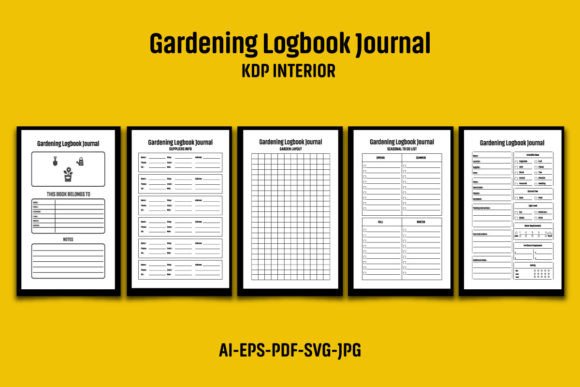
Gardening Logbook Journal DP Interior: A Practical Tool for Growers and Publishers
There’s a quiet ritual that happens every spring in garden sheds, on kitchen counters, and in the pockets of worn-out overalls: someone opens a notebook, pencils in a date, and marks down the first seeding of radishes or the arrival of a late frost. That simple act of recording is where the Gardening Logbook Journal DP Interior finds its most natural home. It’s not just a set of printable pages—it’s a ready-made skeleton for a physical journal that can capture seasons of soil stories, weather patterns, harvest wins, and the occasional tomato blight heartbreak.
Why a Physical Garden Journal Still Matters
Apps come and go, but paper endures the garden shed’s damp, the greenhouse humidity, and the mud on your hands. Many growers find that physically writing things down cements observations in a way typing never does. A well-structured logbook keeps you from relying on memory when you’re trying to remember where you planted those carrot seeds three years ago or which variety of basil bolted first. The Gardening Logbook Journal DP Interior turns that need into a cohesive system. With 110 pages of guided space, it invites you to document planting dates, germination times, bloom periods, and yield quantities without having to reinvent the layout every time you open the book.
Who Uses a Gardening Logbook?
It might sound like something only serious vegetable growers need, but the audience stretches much wider. Apartment dwellers with balcony container gardens use them to track how much sun the mint gets versus the chives. Permaculture designers sketch out guilds and note when honeybees first appear. Homeschool families turn garden logging into a science project, recording temperature, rainfall, and insect counts. Even flower farmers rely on detailed cut-flower production logs to plan next year’s wedding bouquet availability. The common thread is a desire to notice patterns over time, and a pre-designed interior like this makes it painless to start.
From Hobbyist to Homesteader: Different Needs, One Template
What makes a downloadable interior so flexible is that it adapts to wildly different scales. A hobbyist with three raised beds might fill in daily notes about slug pressure and companion planting experiments. Meanwhile, a small-scale market gardener could use the same 6×9-inch format to log block plantings, succession schedules, and market sales notes. The Gardening Logbook Journal DP Interior doesn’t lock anyone into a single methodology. Because users can edit the AI and EPS source files, they can tweak section headings—perhaps “Pest Sightings” becomes “Frost Dates” for a high-altitude grower, or “Seed Inventory” expands into a full seed-starting tracker. That’s the quiet power of having the raw design files rather than a static PDF alone.
How a Pre-Made Interior Simplifies KDP Publishing
For anyone building a passive-income stream on Amazon KDP, creating a planner interior from scratch eats hours of design time and trial-and-error with margins and bleeds. This product removes that friction. The Gardening Logbook Journal KDP Interior arrives as a set of high-resolution, print-ready files already sized at 6×9 inches with a proper bleed (actual dimensions 6.12 x 9.25 inches). That means the guesswork around trim lines and safe zones is already solved. You still get to add your brand’s logo or a unique graphic to the interior pages—and you should, because Amazon’s systems sometimes flag duplicate content when similar templates are uploaded unchanged. A small custom touch turns a stock asset into your own distinct journal.
The Flexibility of Editable Source Files
Receiving an AI file, an EPS, an SVG, and a ready-to-go PDF might feel like overkill until you need to change the paper color or adjust the font for a senior gardener who needs larger type. The inclusion of Illustrator CS6-compatible files means you aren’t locked into the newest software; even older design programs can open them. The black-and-white interior keeps printing costs low—a huge consideration for KDP publishers who want to price competitively while still earning royalties. And because all page elements are made to be easily color-changeable, you could offer a seasonal variant (autumn-toned headers) without starting over from scratch. That’s more than convenience; it’s a business lever.
Designing a Kit That Actually Works for a Gardener
A good logbook interior needs to breathe. Squeezing too many lines onto a page leaves no room for messy handwriting, sketches, or the pressed leaf someone inevitably tucks inside. The 110-page count of this journal strikes a balance—enough space to carry a gardener through multiple seasons without becoming unwieldy or expensive to print. The resolution (300 DPI) ensures that even tiny garden plot diagrams stay crisp. Real-world garden journals get dirty, full of soil smudges and water spots; sharp print quality holds up under that kind of use. If you’re publishing this as a paperback, your customers will appreciate that the text doesn’t feather when they write with a fountain pen or garden pencil.
Using the Journal to Track Microclimates and Soil Health
One of the most underrated uses is tracking microclimate quirks. A gardener might note that the south-facing slope warms up two weeks earlier than the shaded bed, or that the area near the stone wall stays frost-free longer. Over a few years, these observations become a personalized almanac. A pre-structured interior gives each observation a consistent home—temperature columns, rainfall logs, soil amendment notes—so comparisons across years become easy. The Gardening Logbook Journal DP Interior can hold space for soil test results (pH, nitrogen levels) and which amendments were applied, turning guesswork into a replicable data set.
Turning a Passion Project into a KDP Business
Many of the most successful low-content books on Amazon are built from strong templates that speak to a specific community. The gardening niche is large, passionate, and evergreen. A journal tailored to vegetable gardeners, herb growers, or flower enthusiasts can find a steady audience if the interior feels thoughtful. The downloaded ZIP file includes not only the PDF and editable vectors but also five JPG preview files, which help immensely when crafting the product listing’s marketing images. You can use those to mock up an appealing cover and showcase a few interior pages without scanning a physical book. Combined with a well-researched title and subtitle, this Gardening Logbook Journal KDP Interior becomes a product launch kit in itself.
Real-World Examples of Journal Layout Strategies
Imagine filling a page with “Seed Starting Log” columns: variety, date sown, heat mat temp, germination date, and final transplant date. The next spread might be a weekly “Garden Walk” section where you sketch a quick map of problems spotted—aphids on the kale, powdery mildew on the squash. A monthly “Harvest Tally” page lets a home cook see that the ‘Sungold’ tomatoes produced 40 pounds last summer, so maybe they’ll plant fewer next year. These aren’t hypotheticals; they’re how people use structured paper journals. The difference is that with an editable interior, a publisher can tweak the labels to match the most common gardening vocabulary their target audience uses.
What to Watch For Before You Upload
Amazon KDP has a low tolerance for interiors that look identical to other books. The product’s documentation clearly states you need to add your own logo or graphic to the interior before publishing. That’s not a suggestion—it’s a safeguard. A simple header image, a distinctive page number style, or a subtle background pattern can make all the difference. Also, double-check the bleed settings. The files are set up with a 6.12 x 9.25-inch overall dimension for a 6×9 trim, but you’ll want to confirm that critical text doesn’t creep too close to the edge. Test prints at home or through a POD service can save returns and bad reviews.
Customizing Without Overcomplicating
Some people hesitate to buy editable interiors because they think they need to be designers. The truth is, minor tweaks go a long way. Opening the AI file and changing a single headline font to match your cover’s typography is a ten-minute job. Swapping a color swatch to shift from pure black to a softer charcoal can give the interior a warmer feel. The files are built in CS6 versions, so compatibility is broad. If you’re brand new to vector software, the SVG can be opened in free programs like Inkscape. You don’t need to rebuild pages—just personalize enough to make the journal unmistakably yours.
The Role of High-Resolution Templates in Print Quality
A recurring frustration with some print-on-demand interiors is blurry lines or fuzzy text when customers receive the physical book. At 300 DPI, line art remains sharp, and any grid lines for gardening logs stay thin and precise. That might sound technical, but for a gardener trying to read back their tiny notes on July rainfall, legibility matters. The Gardening Logbook Journal DP Interior delivers that clarity while keeping the file size manageable inside a ZIP. Extraction is straightforward with standard tools like WinZip or even a double-click on most operating systems.
Beyond the Backyard: Community Gardens and Urban Plots
Shared gardens add another layer of usefulness. Community garden coordinators could customize a few pages as a logbook for plot renters, tracking when plots are prepared, what common areas need weeding, and which volunteer days have the best turnout. School gardens often combine lessons with journaling; a teacher might print selected pages from the PDF as handouts for a unit on plant life cycles. The fact that the interior is black and white makes photocopying and school printing budgets friendlier. And because the product is a digital download, you can generate as many copies as needed for these small-scale, non-commercial uses after purchase.
Observations on Durability and Practical Use
No one wants a journal that falls apart by midsummer. When you publish the paperback, selecting a quality paper stock and a sturdy cover finish will complement the interior’s layout. Gardeners often keep their journals in tote bags or on damp greenhouse shelves; a smudge-resistant cover and pages that don’t ghost when written on with gel pens are small details that create loyal repeat customers. If you’re using the interior yourself rather than selling it, consider printing it on heavier paper and binding it with a lay-flat coil—the interior is designed with full pages, so a wire binding won’t chop off important tables.
Making It Your Own While Staying Helpful
The ultimate goal of using a pre-made Gardening Logbook Journal KDP Interior isn’t to churn out a generic product. It’s to give yourself a launchpad that you can shape around the specific gardeners you want to serve. Maybe that’s the balcony herb grower who needs monthly calendar grids, or the heirloom tomato enthusiast who wants variety-tracking tables with flavor notes. The files you receive—AI, EPS, SVG, PDF, and JPG previews—give you every possible starting point. Then your knowledge of gardening, your aesthetic sense, and a bit of patience with Adobe Illustrator or alternative tools help you turn a good template into a genuinely useful journal. The consideration that matters most isn’t how quickly you can list it, but whether the end product will actually help someone have a better, more observant growing season. That’s the kind of book people keep, recommend, and repurchase year after year.